


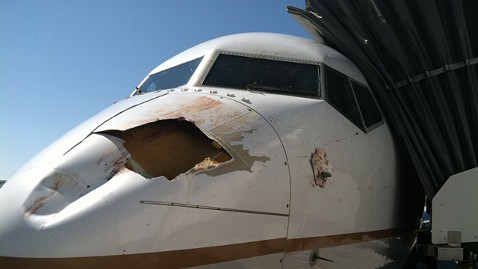
When birds and planes collide, the results can be deadly. That's why airports around the world work hard to keep birds away, even resorting to shooting or poisoning large flocks.
One Ohio airport is now experimenting with a new, gentler way to avoid bird strikes: planting tall prairie grass.
Heavy birds like geese — which cause the most damage to planes — are believed to avoid long grasses because they fear predators might be hiding within. So officials at Dayton International Airport are converting up to 300 acres of the airfield's 2,200 non-aeronautical acres into prairie grass. The goal is, by the end of this year, to plant the tall grass under the takeoff and landing paths.
There are more than 10,000 airplane bird strikes a year in the U.S. Most do little or no damage to the plane. The most frequent problem is damage to the engines. The FAA estimates that such damage costs the industry $950 million a year.
But some cause catastrophic damage. The forced landing of US Airways Flight 1549 in the Hudson River in 2009 — often called The Miracle on the Hudson — occurred after Canadian geese were ingested in both engines, causing the plane to lose power. Nobody died when the plane glided into the river.
The passengers of Eastern Air Lines Flight 375 in 1960 weren't so lucky. The plane struck a flock of European starlings during takeoff. All four engines were damaged and the aircraft crashed in Boston harbor; 62 people died.
Globally, wildlife strikes have killed more than 250 people and destroyed over 229 aircraft since 1988, according to the Federal Aviation Administration. In the past 23 years, there were 25 fatalities and 279 injuries linked to wildlife strikes in the U.S.
A little more than half of bird strikes occur from July to October, which is when young birds leave nests and fall migration occurs.
Between 2001 and 2013, there were 218 wildlife strikes at Dayton. The majority involved doves, pigeons, sparrows and other small birds that didn't cause severe damage. The airport sees 56 commercial planes landing and taking off each day. Two-thirds of those are smaller regional jets.
Airports often buy large parcels of adjacent land to create a buffer zone and limit the number of local residents affected by loud jet engines. Newer airports tend to be built next to tracts of empty land. Those large fields happen to make great rest stops for migrating birds.
"We operate airports in a smaller and smaller environment," says Terrence G. Slaybaugh, director of Dayton's airport. "If we are going to protect the long term use of airports in an increasingly populated area we need to be less intrusive and find ways to contribute in a positive way to our surroundings."
The thick grass has other benefits: preventing water runoff, taking carbon dioxide out of the air and requiring only one mowing every three years.
Bird lovers are also excited about the use of non-lethal methods to keep birds away from the airport.
The airport's neighbor, the Aullwood Audubon Center and Farm, has been working closely with aviation officials on the tall grass project.
"It's a watershed moment. Our airport is embracing it," says Charity Krueger, executive director of the center.
Still, Dayton airport has to prove that the tall grass is the best approach. The tactic could backfire: in the past, the FAA notes, such grasses have led to increased rodent populations, a food source for raptors. Dayton's initial test will run for three years.


