Showing posts with label Delta Air Lines. Show all posts

Wednesday, 20 August 2014

Airlines on Watch for Ash as Icelandic Volcano Rumbles

Airlines are on alert as one of Iceland’s biggest volcanoes rumbles to life, threatening ash clouds that could force flight cancellations across the North Atlantic, the busiest international travel market.
Air France (AF), Deutsche Lufthansa AG (LHA), EasyJet Plc (EZJ) and Delta Air Lines Inc. (DAL) are among carriers watching the Bardarbunga volcano. Iceland’s Civil Protection Agency began evacuating the area north of the volcano today after deciding yesterday to raise the eruption risk to “orange,” the second-highest level.
The seismic activity raised concern that airlines may face a repeat of the 2010 disruptions when a cloud belched from the Eyjafjallajokull volcano forced carriers to erase more than 100,000 flights and caused about $1.7 billion in lost revenue. Ash is a menace to jetliners because the glass-like particles can stop turbines by melting and congealing.
Airline traffic in Northern Europe would be affected “if the winds, as we’re seeing them today, continue” in an eruption, said Melissa Anne Pfeffer, atmospheric volcanologist at the Icelandic Met Office.
Eurocontrol, the region’s air traffic manager, said there is currently no impact on aviation from the volcano. Bardarbunga lies beneath Vatnajokull, Europe’s largest glacier, and last erupted in 1996. Iceland authorities have recorded about 800 earthquakes in the area since early yesterday.

Tracking Magma

“If the volcano erupts -- which we don’t know -- how explosive or non-explosive the eruption is depends entirely on where the magma reaches the surface,” Pfeffer said.
Molten rock bubbling up under the icecap would create “a more explosive eruption” with the combination of high heat and a sudden meltdown of frozen water than one that occurs in the open, Pfeffer said.
Investors are monitoring the threat of travel tie-ups in Europe, Helane Becker, a New York-based aviation analyst with Cowen & Co., wrote in a note to clients today.
“We have gotten more than a handful of calls on this subject, and while the potential impact could be significant, it is tough to handicap how this even will play out,” Becker said. “The European airlines have the most exposure to this potential event.”
The three biggest U.S. carriers -- American Airlines, United Airlines and Delta -- also serve Northern Europe. Representatives for the U.S. airlines and Federal Aviation Administration said operations were continuing as normal while they monitored the volcano.

‘Always Prepared’

“We’re in dialogue with authorities awaiting their directions in case of eruption,” Trine Kromann-Mikkelsen, a spokeswoman for Sweden’s SAS AB (SAS), said by e-mail. “We are always prepared for irregularity and have experience from last time.”
The Eyjafjallajokull blowup prompted European officials to close the majority of airspace in the region for six days, stranding 10 million passengers. There was less disruption to travel from a 2011 eruption, which was smaller and only affected airports in Iceland and northern Germany for a few hours.
“Europe is more prepared to deal with volcanic ash these days,” Eurocontrol said in a statement. “We have better mechanisms in place than we did in 2010.”
EasyJet, a Luton, England-based budget carrier, said that in the event of an Bardarbunga eruption, it plans to work with partners including Icelandic officials, planemaker Airbus Group NV (AIR), Nicarnica Aviation, which developed technology to detect airborne volanic ash, and FutureVolc, a 26-partner group funded by the European Commission.

Ash Detection

The team will “ensure that ash from it is detected and charted from space, using infrared cameras on European weather satellites or through the potential airborne deployment AVOID technology,” EasyJet said in an e-mailed statement. The acronym refers to the Airborne Volcanic Object Identifier and Detector.
NetJets Inc., the luxury aviation unit of Warren Buffett’s Berkshire Hathaway Inc., has a crew of meteorologists to track disruptive weather and incidents like the 2010 ash cloud, said Christine Herbert, a spokeswoman. During the 2010 flight shutdown, NetJets helped clients relocate outside of the ash zones so they could be picked up in private jets, Herbert said.
“We are watching it, and our customers that may be affected will be advised based on the recommendations of our weather team,” Herbert said by e-mail. “We are in contact with the local authorities so we can react instantly if the situation changes, but at present this is not affecting any operations.”

Saturday, 9 August 2014

British and US airlines among those to suspend flights over the conflict zone

British Airways announced yesterday that it was suspending all flights over Iraq.
 
A spokesman for Britain's flagship carrier said that the move was “temporary” and that it would "keep the situation under review". Flights that will be affected include those to Dubai and Oman. 
 
The move follows a similar decision taken by the US Federal Aviation Administration (FAA), which said that it was banning all US airlines from flying over the country until further notice because of the “hazardous situation” engendered by fighting between security forces and the Islamic State (IS).
 
The Islamic militant group has been taking control of large parts of northern Iraq and Syria over the past few months. US air travel below 30,000 feet in the area was already banned by the FAA on 31 July.
 
This morning, Australian airline Qantas followed suit and announced that it would be suspending flights. Other airlines that have already put a temporary ban on flights over the troubled country include the UK's Virgin Atlantic Airways, Dubai-based Emirates, Air France and Lufthansa.
 
Yesterday, the US launched an airstrike into the country to tackle the Islamic militants, after being given authorisation to do so by President Barack Obama. 

Friday, 8 August 2014

With fewest canceled flights, Delta wins best airline title

Delta is the best airline in the U.S., that is, if you are looking for fewer canceled flights or mishandled bags and on-time arrivals.

"Of course, we don't have a measurement for the widths of flight attendants' smiles or other intangibles, but if you look at the numbers, Delta comes out on top this year," said George Hobica, founder and president of Airfarewatchdog, which puts together the annual list.
Delta Air Lines achieved the top score overall, a significant leap from its sixth-place spot in last year's list. The Atlanta-based carrier got top marks for the fewest canceled flights and most improved customer service.
The best rating for on-time arrivals went to Alaska Airlines. Bad weather can often hinder flights, particularly in America's northern most state which has harsh winters, but Hobica said the Alaskan airports "are well-versed in handling snow."
It helps that many of Alaska Airlines' flights are to warm weather airports in Hawaii, California and Las Vegas.
JetBlu wins for bumping the lowest number of passengers from flights, according to the list. Hobica said it's part of the airline's culture to "never intentionally overbook flights."
However, Jetblue also had most canceled flights. It is based in John. F. Kennedy International airport in New York City, one of the most congested airports in the country. This past year's snow-laden winter didn't help either.
Fliers who want to arrive at their destination with their luggage intact should go with Virgin America. Hobica said this is primarily because the "vast majority" of the airline's flights are nonstop, without connections. "It's during connections that most bags get mishandled," he said.
The worst offender for mishandling luggage is Southwest Airlines. But the saving grace is that the airline charges no fees for the first two bags unlike its competitors, said Hobica.
As a result, he said, "they handle the most bags."

Tuesday, 5 August 2014

Delta: Revenue rises on higher fares, fuller planes

Delta Air Lines said Monday that passengers flew more and paid higher average prices than a year ago, indicating that there has been no let-up in solid demand for air travel.

Delta said that a key revenue figure rose 3% last month compared with July 2013. The increase in passenger revenue for every seat flown one mile indicated that the airline was able to fill a few more seats and charge higher average fares.

The airline predicted that the revenue figure would rise by between 2% and 4% for the entire July-through-September quarter.

Delta, the third-largest airline operator, said passengers flew 19.97 billion miles last month, up 2.8% from July 2013. Domestic traffic rose 4.7% while international travel increased just 0.3%.

The airline boosted passenger-carrying capacity by 2.2% -- that is usually done by adding more flights or using bigger planes. The average flight was 87.5% full, compared with 87% a year earlier. Domestic flights accounted for the increase, while international flights had more empty seats because Delta added capacity.

Shares of Atlanta-based Delta fell 51 cents to $37.07 in midday trading. They began the day up 37% in 2014.

Saturday, 2 August 2014

U.S. citations against airlines soar

Sometimes airfares are just too good to be true.

Southwest Airlines sent an online offer to about 10 million people in January 2013 for flights from Dallas to Branson, Mo., for a bargain price of $66. But fliers who tried to book the fares couldn’t find seats for the sale period — an error the airline blamed on a technical glitch.

Unfair and deceptive practices, such as promoting fares that don’t exist, are by far the most common violation of passenger rights by the nation’s airlines, according to three years of U.S. Department of Transportation citation records.

The Southwest violation was among more than 500 total citations — resulting in $20.9 million in fines — issued from 2010 to 2013 to all airlines and travel agencies at a time when passengers were howling mad over new airline fees, cramped seating and mergers that cut service to smaller cities.

A Los Angeles Times analysis of federal citations during that time period also found:

The most common citation for unfair and deceptive practices was a failure to disclose the full fare for a flight, including taxes.

The steepest penalties were imposed against airlines that mistreated disabled passengers.

Only about half the fines imposed by the Department of Transportation were collected, with the balance either suspended or directed to be used to improve airline services.

In response to an outcry from passengers, the Department of Transportation cracked down on violators and adopted new passenger rights rules that took effect starting in 2010.

In addition to requirements to advertise full fares, the new rules impose hefty fines on airlines that strand passengers on the tarmac for hours. Airlines must also refund checked-bag fees for lost luggage and give customers bumped from overbooked flights compensation of as much as $1,300, up from the previous maximum of $800.

These new rules focus primarily on the treatment of passengers — not on safety or mechanical issues, which are regulated by the Federal Aviation Administration.

With renewed attention on passengers, the number of citations issued by the Department of Transportation nearly doubled. From 2010 to 2013, the number of citations imposed on airlines averaged 54 a year, compared with the average of 28 for the previous four years, according to federal citation records.

Although passenger rights groups have welcomed the changes, some airline critics believe the new rules don’t go far enough and are calling for steeper fines to change the behavior of repeat violators.

“I don’t think these fines do anything to mitigate or stop the bad behavior,” said Albert Rizzi, a blind traveler who was kicked off a US Airways plane in November 2013 when a flight attendant complained that his service dog had wandered into the aisle. “There are no consequences involved.”

Of the 521 violations in 2010-13, the department cited airlines 181 times for violating rules of unfair and deceptive practices, such as Southwest’s nonexistent discount airfares to Branson, according to agency records.

In each violation, the airlines and travel agencies signed consent orders to settle the allegations of wrongdoing raised by the Department of Transportation to avoid civil litigation.

Ten months after Southwest was cited for promoting those fares, the department fined the airline $200,000 for running television ads touting another super-low fare from Atlanta that did not exist — another error, according to the airline.

A rule requiring airlines to advertise the full cost of a flight took effect in January 2012. Since then, violations of the rule have led the federal agency to fine the nation’s airlines and travel agencies 57 times.

For example, American Airlines advertised in February 2013 that children fly “free” as part of a ski resort package. But the fine print said only the airfare charges were free — travelers still had to pay taxes and fees.

American Airlines agreed to a $20,000 fine but disputed that it had broken any rules.

Congress is now considering a bill, supported by most airlines, that would eliminate the full-fare rule, allowing airlines and travel agencies to advertise the fares and fees separately.

The heftiest fines — nearly four times higher than the average penalty — were issued to airlines that neglected or mistreated disabled passengers, according to federal records.

Delta Air Lines has been assessed the largest fine — $2 million — for 22 violations from 2007 to 2011.

In one incident at New York’s John F. Kennedy International Airport, a disabled 79-year-old woman said she was left unattended in a terminal for more than two hours because she declined to pay a Delta worker $10 to push her wheelchair.

Delta paid $750,000 of the total fine. The balance was credited to the airline for money it spent to improve services for disabled passengers, such as increasing employee training and investing in technology to ensure wheelchairs are provided to fliers who request them.

Eight years earlier, Delta was fined $1.35 million for similar violations but was required to pay only $100,000 of the fine, with the balance either forgiven or credited to the airline for making improvements to services for disabled passengers.

Critics say Delta’s repeated violations show that federal fines don’t fix bad behavior and inflict little pain on an industry that generated $12.7 billion in net profits in 2013.

“In the case of multiple violations, the fines should be greater and they shouldn’t be waived,” said Paul Hudson, president of FlyersRights.org, a nonprofit passenger rights group. “They should increase exponentially.”

From 2010 to 2013, only $11.5 million of the $20.9 million in fines was paid to the U.S. Treasury, according to records.

Rizzi, the disabled passenger who was forced off a US Airways flight, noted that his incident occurred only a week after the airline agreed to pay $1.2 million for allegedly discriminating against passengers with disabilities.

“My sense is that these fines are meaningless to the airlines,” he said.

American Airlines, the parent company of US Airways, said it takes seriously its responsibility “to provide safe, reliable and convenient travel for passengers with disabilities,” and has committed to spend $2 million a year to improve service to disabled passengers.

The Department of Transportation believes the fines are having an effect.

“We’ve made incredible progress through the use of fines and other methods,” said agency spokeswoman Casey Hernandez, adding that the penalties — and threat of penalties — have reduced violations.

With disgruntled passengers turning to social media and blogs to vent their frustrations, airline experts say the companies are eager to avoid the bad publicity.

“I think in the grand scheme of things, these fines are not a lot of money,” said Nelson Granados, an associate professor of information systems at Pepperdine University, who worked in the airline industry for eight years. “But the impact to reputation is what concerns airlines.”

Friday, 27 June 2014

Ex-Delta employees indicted in $22M false invoicing scheme

Two former Delta Air Lines Inc. employees were indicted for allegedly defrauding the Atlanta-based carrier out of $22 million through a false invoicing scheme.
According to U.S. Attorney Sally Quillian Yates, the indictment, and other information presented in court: Paul Anderson had been an employee of Northwest Airlines since 1979. In 2008, Delta (NYSE: DAL) bought Northwest. The two airlines merged into a single company in December 2009, at which time Anderson became an employee of Delta working in its Minneapolis, Minn., office.
The indictment alleges from at least 2004 through 2013, Anderson was involved with Michael Yedor in a scheme to defraud Northwest and, later, Delta, by submitting numerous false invoices on behalf of a company, Airborne Voice and Data, purportedly owned by Yedor. The invoices sought payment from the airlines for goods provided and services supposedly rendered by Airborne Voice and Data, when in fact, both Anderson and Yedor knew Yedor’s company had not provided any such goods or services.
The indictment also alleges Yedor sent the invoices to Anderson to be approved. Anderson approved the fraudulent invoices, which caused the airlines to issue payments to Airborne Voice and Data. In exchange for approving each of the invoices, Anderson received a portion of the proceeds of the fraud.
The indictment alleges Yedor and Anderson caused Northwest and Delta to issue some $22 million in payments to Airborne on the basis of the false invoices between 2004 and 2013.
Yedor, 62, of Los Angeles, Calif., and Anderson, 57, of Apple Valley, Minn., were indicted on June 10, 2014, and have each been charged with conspiracy to commit mail fraud and ninety-six counts of mail fraud.

Monday, 23 June 2014

The A380 Is Coming to America? Yes, Says a Guy Who Leases Them

Mark Lapidus has a bold prediction: Delta Air Lines will be the first U.S. carrier to fly Airbus massive A380 superjumbo—even though Delta executives have repeatedly said they don’t want the plane.

Lapidus is the chief executive officer of aircraft leasing company Amedeo and so has a deep financial interest in making his rosy forecast come true: Dublin-based Amedeo, the only lessor of the A380, has four of the twin-deck jets arriving from Airbus in 2016, with 16 more in the following four years.

In the seven years it’s been flying, the big plane has failed to crack a U.S. fleet. U.S. carriers contend that the plane—which carries almost 600 people in the configuration Amedeo touts—is too big for their networks, which are structured around frequencies in major business markets and matching seat inventory tightly with demand, a strategy of engineering scarcity to maintain profits.

That’s worked: U.S. airlines are now the most profitable in the world. “They all have reasons to be ideologically against it, and that’s part of our challenge,” Lapidus says. “It will take time.” He’s ready to try, embarking on what Bloomberg News earlier this month called “a lonely crusade“ to find new customers in North America for the world’s largest commercial jet. Airbus has 324 orders for the A380, most going to Emirates, the largest buyer of the model.

The crux of Amedeo’s pitch to North American airlines is that they’ve ignored the potential the A380 offers to segment cabin space much more than they can on their current long-haul fleets. Many airlines reduced their premium cabin capacity during the financial downturn, but now they’re losing first- and business-class customers to rivals, a phenomenon called “spill.” Lapidus argues that if U.S. airlines such as Delta and American Airlines improve their offerings, they’ll increasingly be able to win the class of global business travelers who want to fly only the best airlines. He says premium economy is a revenue windfall and Airbus’s behemoth is the most efficient way to offer it.

Lapidus thinks Delta is most likely to yield. It has a record of finding niches for aircraft models that its rivals have avoided, especially if the planes are older and can be purchased for cheap on the secondary market. He cites Delta’s decision to replace many of its 50-seat regional jets with larger, 110-seat Boeing 717s, which boosted the airline’s capacity without requiring a larger fleet. Compared with a regional jet, the Boeing 717 offers 120 percent more seats at only 60 percent greater cost, and is more spacious and passenger-friendly, Delta said. “Every logical stage [Delta] used in making that (717) decision is exactly the same thing I would have used in advocating the A380,” Lapidus says. “So if they apply the same metrics, it would make sense that they would follow that logic.”

So far, Delta has shown little interest. The airline requested proposals from Boeing and Airbus for as many as 50 wide-body jets to replace its four-engine Boeing 747s and a large fleet of older 767s. Delta isn’t exploring the A380 as part of the proposals it will peruse this summer; last week two Delta executives at separate events said the A380 doesn’t fit their needs. ”We see a lot of efficiencies … in twin-engine aircraft, which make up the bulk of our fleet, and the A380 just doesn’t fit into that scope,” Delta spokesman Michael Thomas said on June 20.

It’s worth wondering: Does it matter to Amedeo or Airbus if a U.S. airline flies the A380 when it has customers in the Middle East, Asia, and Australia? “It probably doesn’t, but part of this story is (about) changing perceptions,” Lapidus said in a telephone interview Friday night from his home near London’s Heathrow Airport. U.S. airline decisions can have an enormous influence on operators all over the world, he added.

Lapidus is hoping for a meeting in Atlanta to tout the A380; he thinks the big jet would best fit Delta’s existing Heathrow services, which it operates as a joint venture with Virgin Atlantic Airways. Delta owns 49 percent of Virgin Atlantic, which has orders for six A380s scheduled to begin arriving in 2018. It’s unclear if Virgin Atlantic still wants the planes, having deferred them several times. “I think Delta, for all of their rhetoric about four-engine planes … is going to look at it intelligently,” Lapidus says.

Sunday, 22 June 2014

Delta Air Lines seeks to secure 'world's most trusted' slogan

Delta Air Lines may be ready to adopt a new slogan. Delta has filed for trademark protection with the U.S. Patent and Trademark Office for what sounds like the airline’s newest motto: “The World’s Most Trusted Airline.”

Delta has used several slogans over its 85-year history, including “We love to fly, and it shows,” and, more recently, “Keep Climbing.”

A Delta spokesman declined to comment. Industry experts say airlines often seek trademark protection for slogans simply to prevent competitors from using it.
Already taken: United Airlines’ “Fly the friendly skies” and American Airlines’ “the new American is arriving,” adopted after the merger with US Airways last year.

Tuesday, 17 June 2014

Airbus A380 superjumbos would be a bad fit

The Airbus A380 won't be flying for Delta Air Lines anytime soon.

That's not a huge surprise, as industry observers have long regarded the superjumbo A380 as a bad fit for the fleet plans at most U.S. carriers. But surprise or not, a Delta executive affirmed that the world's largest passenger jet is not currently being considered by Delta.

"We don't see an application for the A380 in our network," Steve Dickson, Delta's SVP for flight operations, is quoted by Reuters as saying Monday at the 2014 American Institute of Aeronautics and Astronautics Forum in Atlanta.

Dickson adds four-engine planes — such as the A380 — were "not viable" aircraft options for most of Delta's markets, according to Reuters.

"The reliability of the two-engine airplanes and the efficiency of them is just too compelling," Dickson says.

Delta has recently put out to aircraft manufacturers a request for proposals for an order of up to 50 wide-body jets. The order would be to replace Delta's aging Boeing 747 and 767 wide-body aircraft, according to Reuters.

In addition to Airbus' A380, Dickson's comments also would seem to indicate that Delta will be cool on the idea of ordering new models of Boeing's 747, also a four-engine aircraft.

Tuesday, 3 June 2014

Delta starts nonstop Seattle to Seoul route

Delta Air Lines Inc. has added a nonstop route from Seattle to Seoul. The flight marks Delta's fourth nonstop international route added from Seattle-Tacoma International Airport in a year, including London-Heathrow, Shanghai-Pudong and Tokyo-Haneda.
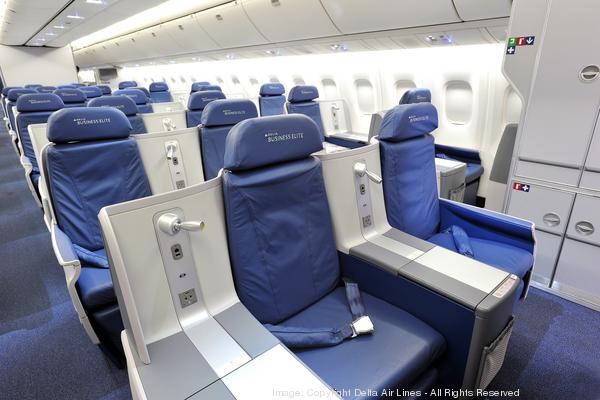
The Seoul flight will operate using a 210-seat Boeing 767-300ER aircraft with 35 full-flat bed seats in BusinessElite, 32 seats in Economy Comfort and 143 Economy class seats, the Atlanta-based carrier said in a press release. Delta is the only carrier to offer full flat-bed seats with direct aisle access in Business Elite on every long-haul international flight from Seattle along with Economy Comfort seating and entertainment on demand in every seat throughout the aircraft, the company said.
"Delta's Seoul service is another key addition in our rapidly expanding international portfolio for corporate and leisure customers," said Mike Medeiros, Delta's vice president – Seattle. "The Seattle market is geographically positioned to optimally connect traffic to all of our Asia destinations, which are the leading commercial centers in the region."
Delta said in August it wanted to add the route. Such routes require government approval.
Delta last week announced service from Seattle to several popular ski and beach destinations for this fall and on June 16 will celebrate a new international flight with nonstop service to Hong Kong.
In addition to the recently added international service, Delta also currently operates nonstop flights from Seattle to Amsterdam, Beijing, Paris-Charles de Gaulle and Tokyo-Narita. By this summer, Delta will offer more international service from Seattle than all other carriers combined with more than 2,500 daily long-haul international seats as part of the market's 86 peak-day departures to 26 destinations, the company said.

Friday, 23 May 2014

Delta Air Lines and Virgin Atlantic synchronise transatlantic schedules

Delta Air Lines and Virgin Atlantic Airways will transfer operations for non-stop flights connecting London-Heathrow to Atlanta Hartsfield-Jackson International Airport and Los Angeles International Airport this winter, offering more choice for the airlines’ customers on key routes across the Atlantic. Effective October 26th, 2014, Delta will begin operating one of two daily Heathrow-Los Angeles flights currently operated by Virgin Atlantic. This new Delta service will mark the airline’s first non-stop flight between Los Angeles and London Heathrow and is Delta’s seventh non-stop destination between London and the United States. Virgin Atlantic, meanwhile, will begin operating one of Delta’s three daily flights between Heathrow and Atlanta. 

The new services will expand the award-winning service offered by both carriers to customers as well as provide greater choice for travel between the UK and North America.
The two airlines will codeshare on each other’s operated services, allowing Delta and Virgin customers seamless access to the expanded network. “It’s great to see how our partnership with Delta is already proving fruitful to our customers,” said Craig Kreeger, Virgin Atlantic chief executive. “In less than a year we will have co-located key business routes, delivered schedule changes to benefit our customers and provided enhanced experiences to our frequent fliers, who gain from reciprocal lounge access and the ability to earn and burn across both carriers.

“This is just the beginning of demonstrating how a true joint venture between airlines should be operated to benefit customers.”

This announcement also shows how the partnership, which launched on January 1st, 2014, is increasing the network of each carrier. Virgin Atlantic will have access to Delta’s Atlanta hub, the busiest airport in the world, for the first time, providing expansive and unprecedented access for Virgin Atlantic customers to connect to points throughout the United States, Canada, Mexico and the Caribbean.  The airline will now be able to offer more than 100 additional international and domestic connections to its customers. This brings the total number of connections available through the partnership to more than 200.

Wednesday, 21 May 2014

Delta to take over London-Los Angeles flight from Virgin Atlantic

Delta Air Lines and Virgin Atlantic will start flying their own planes on routes previously operated by the other.
Beginning Oct. 26, Delta will operate one of Virgin’s two routes between London Heathrow and Los Angeles, the Atlanta-based airlines first nonstop between the two cities.
Delta will operate a B767-300 ER plane for the flight. Virgin Atlantic will continue to operate two daily services to Los Angeles until that date.
Both airlines have had a partnership since January 2014, aimed at increasing to network of each carrier.

Delta regains technology systems from Travelport

Delta Air Lines Inc. will buy back from Travelport the data and intellectual property rights central to its passenger service and flight operations systems.
Financial terms were not disclosed.
With the deal, Atlanta-based Delta (NYSE: DAL) will be the only U.S. airline to directly control certain technology systems. The agreement includes:
  • Transfer of direct control and operations for Delta’s passenger service systems and flight operations systems.
  • A transition of the development software that does not require a technology migration event so there is no effect to Delta customers.
  • Transition of more than 175 technology professionals to Delta on July 1.
Travelport will continue to run the system infrastructure for the Delta platform in its Atlanta data center.
“These systems are the data and operational backbone for more than 180 technology applications used to run our airline every day,” said Delta CEO Richard Anderson, in a statement. “By bringing the systems along with the highly skilled people who support them under Delta’s direct management, we gain greater flexibility and control over the technology enhancements that will continue to improve our operational performance and passenger experience.”

Friday, 16 May 2014

How to get compensated for air travel delays

Last summer, Mark Wilson waited in a Rome airline terminal for a connecting flight to London on his way home to New York. And waited. And waited. By the time he arrived in London four hours late, the final New York-bound flight had departed.

Wilson was offered a room at an airport hotel, which he declined. He was also due a $550 cash penalty by U.S. law but says he never knew about the rule. The money sat unclaimed for more than two months, until he used the service Refund.me to collect.

“I travel constantly. I had no idea that law existed,” says Wilson, 36, an investment banker.

Indeed, the right of consumers to collect cash from airlines for international as well as domestic flight delays is not well known, says Christopher Elliott, author of “How to be the World’s Smartest Traveler” and ombudsman for National Geographic Traveler. “The rules are obscure, and airlines intentionally keep them that way.”

Consumers can fill out the required forms themselves and deal directly with the airlines. You can access the U.S. forms through the Department of Transportation’s Aviation Consumer Protection Division. European fliers can find forms at individual airlines or through the European Union.

But some prefer to skip the extra paperwork and hire someone else to handle it, even though it will cost a hefty percentage of what’s recovered. Service providers include AirHelp and Refund.me.

Either way, fewer than 2 percent of eligible travelers try to claim the cash, and less than 1 percent of travelers receive money, says Nicolas Michaelsen, co-founder and chief marketing officer of AirHelp.

RULES FOR PAYMENTS

Passengers whose flights from Europe are delayed by at least three hours or canceled are eligible for up to about $825, depending on the length of delay and distance of the flight. The average payout is around $600, according to Michaelsen. Flights to Europe and within Europe on an European Union-based carrier are also subject to European Union law.

Domestic U.S. travelers may be eligible for even more money, but under much narrower circumstances. An airline that denies a booked passenger a seat (somebody who is bumped on an oversold flight because there are not enough volunteers to give up seats) and can’t get to their destination within an hour of the scheduled time can collect 200 percent of the one-way ticket price, capped at $650.

A delay of two or more hours is worth 400 percent of the price of the one-way ticket, up to $1,300. The average payout is $643, AirHelp says.

In 2013, nearly 467,000 passengers were bumped from overbooked U.S. flights, according to U.S. Department of Transportation records. A routine airline practice can end your eligibility for a cash payment: if an airline offers you a voucher and you accept it.

“Then all bets are off,” Elliott says.

Data shows that most people take the voucher when offered - only about 57,000 U.S. domestic travelers last year were involuntarily bumped. Airlines are supposed to hand those consumers the rules that govern being bumped from a flight, and payment is supposed to be immediate. But that’s not always the case, travel experts say.

However, United Airlines spokesman Charles Hobart says passenger gate agents are told to immediately settle up with travelers due a payment.

Delta Air Lines last year was fined $750,000 by the Department of Transportation for not following the rules. The airline has since invested in additional training and electronic signature pads to document that passengers were properly notified and compensated, spokesman Morgan Durrant says.

So far, AirHelp has processed about 25,000 claims and says a majority of applicants received a payout, with AirHelp taking a 25 percent commission including tax. Refund.me has a two-tier fee, starting at 15 percent commission plus tax for those who return a signed power of attorney form within 28 days, and 25 percent plus tax for those who turn it in later.

A typical case works like this: Connie Lee, 31, of Oakland, California, was delayed on a trip home from Germany. She filled out an online AirHelp form once she got home, which took about five minutes. A couple of weeks later, Lee ended up receiving about $800 from her airline carrier, minus the company’s 25 percent commission.

“It was a very good surprise,” Lee says.

Wednesday, 7 May 2014

Delta Air Lines to expand Europe service from U.S. hubs


Delta Air Lines will strengthen its leading position in the New York market by offering new year-round daily service from John F. Kennedy International Airport to Zurich Airport and expanded service to Rome's Leonardo Da Vinci International Airport. Zurich and Rome are two important business markets in Europe and provide a valuable link to the financial center of the U.S.

"As the primary business market on the trans-Atlantic, demand continues to increase for more nonstop flights from New York to European destinations," said Gail Grimmett, Delta's senior vice president - New York. "Zurich ranks fourth in terms of business traffic from New York, and our additional service will build on the commercial, tourism and community links between these two cities."

The Zurich flight will be operated using a Boeing 767-300ER aircraft featuring full flat-bed seats with direct aisle access in the BusinessElite cabin. Daily Zurich service will begin effective June 16, 2014 and during the summer will complement the airline's existing service from Atlanta. Rome service will operate daily from April to October on an Airbus A330-300 aircraft, and then five times per week in November, December and March on a Boeing 767-300ER aircraft in conjunction with Delta joint venture partner Alitalia. 

Effective this winter, Delta and its joint venture partners Air France-KLM and Alitalia are also expanding service to key European hubs at Paris Charles De Gaulle International Airport and Amsterdam Schiphol International Airport from Hartsfield-Jackson Atlanta International Airport. From Atlanta, the joint venture will offer additional daily nonstop service for a total of four daily flights to both Amsterdam and Paris, timed to provide customers with more connecting opportunities to destinations throughout Europe, the Middle East and Africa.

"With the most established joint venture across the Atlantic, we are in a unique position to collaborate with our joint venture partners to make full use of our combined fleet and networks to best serve our customers," said Glen Hauenstein, Delta's executive vice president and chief revenue officer. "Delivering more hub-to-hub flying provides a network with higher frequencies and tailored schedules for our trans-Atlantic travelers."


Delta Airlines Cabin Cleaners Protest at LAX

Nearly 100 airport workers who provide cabin-cleaning services for Delta Airlines rallied at LAX on May 6 to protest the hiring of a contractor they say plans to cut worker pay and benefits.
Delta Airlines recently contracted with Gate Gourmet to provide cleaning services for the air carrier.
Tim Maddox, an airport worker and a SEIU member, said he is concerned because Gate Gourmet plans to drop workers’ pay from as high as $14.80 to as low as $8.75 and wants to change to a healthcare plan with higher out-of-pocket costs.
“We already have fought for standards here,” Maddox said at the rally. “The union has allowed us to have decent standards with family healthcare and some vacation time.”
A Delta Airlines spokesman said in a statement that Gate Gourmet has assured the airline it will remain in compliance with all applicable laws and the terms of existing collective bargaining agreements.
“We understand that the SEIU was certified to represent the employees at the prior contractor, but a different union is certified to represent the employees of Gate Gourmet,” Delta spokesman Morgan Durrant said. “Delta is not in a position to influence which union represents the employees of specific contractors.”
Airline workers said during the rally they do not want to go backward at a time when fast food and other service workers are fighting for a $15 per hour minimum wage.
“We want to do the same here at LAX,” Maddox said.
The cabin cleaners are considering holding a strike vote early next week if they feel the dispute is not resolved, according to the union.

Saturday, 19 April 2014

No bomb found on Delta plane at Denver International Airport after threatening note discovered

No bomb was found during a search of a Delta Air Lines plane at Denver International Airport Friday after a threatening note was discovered during the flight from Detroit. Sources told CALL7 Investigator John Ferrugia a flight attendant found a note in a rear galley of the plane threatening a bomb was onboard. Radio traffic recordings captured the Delta pilot informing air traffic control about the threat.

"Flight 1500 now declaring an emergency at this time. We have a written threat aboard the aircraft," the pilot radioed. "Our flight attendant found a note indicating there was a bomb onboard towards the rear of the aircraft."

DIA spokeswoman Julie Smith said the Delta flight had a "possible security threat," but she did not confirm the bomb threat.

"They found the corner of one of the (magazine) pages was ripped out and that was the note that was written on, and said, 'There is a bomb' or something like that," passenger Aaron Baratz told 7NEWS reporter Marshall Zelinger.

"The FBI came on board the plane and asked, of course, did anybody leave the note. They said there was a piece of paper in the back with the word bomb written on it," said passenger Joe Vance.

Flight 1500 landed safely at 4:39 MT and the pilot was directed to taxi the plane to a remote location of DIA where it was met by law enforcement and fire crews. A K9 team searched the plane, passengers and bags, but no bomb was turned up. After the plane landed, passenger Tone Sevy tweeted that passengers could not take anything off the plane or from overhead bins.

"They came on the announcement and they said, 'There's been a threat to the aircraft, everybody needs to turn your phones back off and this is not a request, it's a demand,'" said Baratz.

On Twitter, Sevy added the Delta pilots were "low key [and] put us down fast a couple miles" from the airport. 

"K9 on plane, buses, checking us & personal bags. Sprayed with water before we deplaned," Sevy tweeted. "@Delta And TSA on it. Crazy situation".

Eventually, the 151 passengers and four crew members were allowed to return to the parked plane for their belongings. But Sevy tweeted at 7:30 p.m. that passengers were still being held in buses on the tarmac, waiting to be questioned by the FBI nearly three hours after the plane landed. At about 8:40 p.m., the passengers were released at the terminal.

FBI spokesman Dave Joly issued this statement: "The FBI Denver Division and multiple other agencies responded to a security concern on Delta Flight 1500 this evening at Denver International Airport. Passengers, crew members, and the aircraft were rescreened and interviews were conducted. All of the Delta Flight 1500 passengers were allowed to reclaim their luggage and continue with their travel plans by 10:00 p.m. local time, on Friday, April 18, 2014."

"We currently do not believe a credible threat existed to the flight. Out of an abundance of caution security protocols were implemented and safety measures were closely followed," Joly added.

According to Baratz, the note was found in the back of the plane, but was torn off a page from a magazine in a row around 25 or 27. He said that row included an elderly couple and another passenger who never got up to go to the back of the plane.

"We don't think Delta cleaned the plane before we got back on, which happens all the time, but that's a pretty big thing to miss," said Baratz.
After the passengers were released, passenger Tone Sevy tweeted: "Appreciate FBI, TSA, Delta, just a process no one ever wants to deal with."

We are all OK, all bags and thing on plane, crazy situation. A lot of confusion among everyone.

Thursday, 3 April 2014

Plane rolls off runway after emergency landing at New York airport

A Delta Air Lines Inc flight made an emergency landing at a New York airport on Wednesday after a cockpit indicator signaled a hydraulic system problem, and the aircraft later rolled into a grassy area, an airline official said.
Flight 886, which was carrying 118 passengers and five crew from an Atlanta airport to New York's LaGuardia Airport, was diverted to John F. Kennedy International Airport (JFK) because it has longer runways, Delta spokeswoman Leslie Scott said.

Sunday, 30 March 2014

Delta-Virgin takes up battle for New York-London fliers

Delta Air Lines has been making inroads in the dogfight over the lucrative market for business travel between New York and London, but the newly merged American Airlines Group is fighting back.
Delta is hoping to attract customers through its new partnership with Virgin Atlantic, known for its high-tech and non-traditional approach to flying, and its own boosted profile in New York, where it expanded flights and renovated terminals.
Now under new management, American is trying to bounce back from years of under-investment and market share losses, drawing from its recent merger with U.S. Airways.
The New York-London route is popular with Wall Street executives who are willing to pay for the priciest seats and who often travel at the last minute. Eager for their business, airlines are using their best planes on the route and investing in upgrades such as satellite WiFi and seats that turn into flat beds.

Wednesday, 26 March 2014

Delta Air Lines and Virgin Atlantic Celebrate New Transatlantic Partnership

On Tuesday, March 25 representatives from Delta Air Lines and Virgin Atlantic will visit the New York Stock Exchange and ring The Closing Bell® to highlight their new transatlantic partnership. By coming together, the two airlines will provide more flight choices for travelers on routes between North America and the U.K., in particular improving the travel options for business customers in the New York to London market, the most important business market in the world.