Showing posts with label Electric Plane. Show all posts

Wednesday, 11 June 2014

Airbus electric aircraft takes to the skies

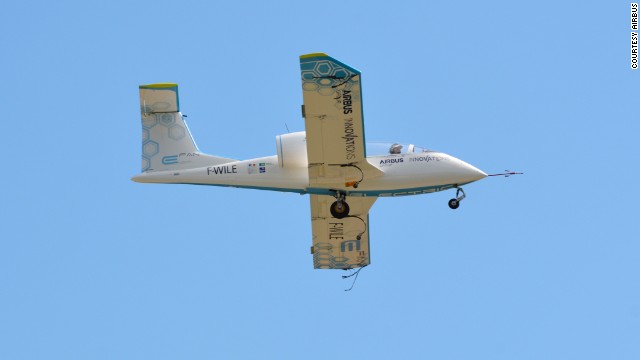
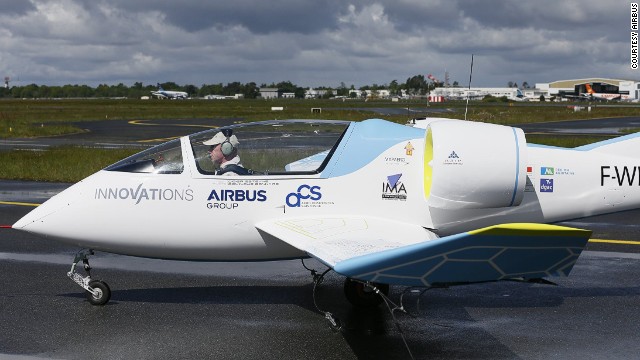
Imagine taking a peaceful flight, gliding along without much noise or any fuel, effortlessly descending into the airport without a trace of emissions. Sounds like a dream? It is. But one we can imagine in the not-so-distant future. E-Fan, the brainchild of parent Airbus Group, is a prototype hybrid electric motor glider which will first be used for training pilots for their license at a school in Bordeaux, France, by 2017. It debuted with its first public test flight in April 2014, and the two-seater electric aircraft is powered by two batteries, producing 60 kilowatts of power, which will be able to run for half an hour.

The E-Fan has been a continuous journey of evolution, says chief technical officer Jean Botti. "This is a learning curve to get to the big ones in the future."

It started five years ago when Airbus Group experimented with the Cri-Cri, a tiny plane based on the 1970s Cri-Cri, one of the smallest twin-engine planes in history. Besides the benefits of noise and emissions reduction, the reduced cost of training pilots with the E-Fan is incredible, says Botti. It costs about two cents per hour to fly the electric plane, a number which is up to 20-50 times cheaper than the normal fuel costs of today's aircraft, he says. Ultimately, these savings will get passed on to the customer, explained Botti, as the electric-powered flight training becomes a reality.

What's ahead for electric?

Eventually, the company has its eye on building planes for regional flights, with up to 90 people flying for three hours, although this is still 15-20 years away, says Botti.

"We're not talking about replacing the A380," he says. But the shorter-term goals also include helicopters with hybrid electric technology.

For Airbus Group, much of the investment is being mobilized by the European Commission's "Flightpath 2050" which aims to cut aircraft CO2 emissions by 75%, and noise levels to be reduced by 65% from their 2000 levels. The goal is to make tens to hundreds of these planes, and Airbus Group says it will be designed by schools with apprenticeship programs in order to help raise up the new engineers of tomorrow. The biggest challenge for E-Fan is developing new energy storage. "We cannot afford to stay with the state of batteries today. We need to go much higher in terms of efficiency," says Botti, adding that the company's new research center in Munich, Germany, will have the capacity to do just that.
Alternative planes take off

It's not just Airbus looking to alternative aircraft to help save energy, cut fuel consumption and reduce noise. There are several others developing alternative aircraft with their own success. Recently, the Solar Impulse 2, a fully solar-powered aircraft, was unveiled by a Swiss duo which will attempt to fly non-stop for 120 hours without any fuel next year. Made of carbon fiber, its predecessor, Solar Impulse, smashed aviation records as it succeeded in the first solar-powered overnight flight, lasting 26 hours in 2010. Another creation is the Dutch-designed, German-built Antares 23E, an electric aircraft with 23-meter wings which can glide for 60 kilometers (37 miles). The Antares 23E can climb to 3,500 meters on a single battery charge.

Saturday, 17 May 2014

Airbus Charged Up About Electric Planes

The Airbus E-Fan took its first public test flight last month, making it the latest in a group of all-electric aircraft to take to the sky.
The flight was not just a media stunt. Airbus Group hopes to eventually develop a hybrid-electric regional plane that could seat 70 to 90 people,according to a report in Reuters. Developing such an aircraft, however, could take up to 20 years.
 PLAY VIDEO
Zeppelins (blimps) were first flown commercially in 1910 by Deutsche Luftschiffahrts-AG (DELAG), the world's first airline in revenue service.
DNEWS VIDEO
In the more near, term, Airbus sees a future for its E-Fan test plane. The composite, two-seater training aircraft is equipped with two lithium-ion polymer batteries (250 volts total) from KOKAM, a leading advanced battery maker, that are housed in the wings. The batteries provide 60 kilowatts of power to the plane's electric motors. The motors drive a variable pitch fan. The plane can fly for up to about 45 minutes, but Airbus says it can eventually get that flying time closer to an hour and 15 minutes.
There are various electric aircraft prototypes across the world, but the difference is that Airbus is one of the world’s leaders in commercial aircraft manufacturing. While the A380 isn't going to go electric anytime soon, any breakthroughs that Airbus develops in electric-powered planes could reverberate through its business.
Unlike some other electric aircraft, Airbus says that the E-Fan was built from the ground up to be electric rather than being based on existing fuel-powered airframes. For example, the landing gear is integrated into the fuselage for low drag, and the energy management and safety features were designed to be driven by electrical propulsion. There is a backup battery for emergency landing.
At the same time, the E-Fan needs to have flight parameters that are similar to existing training aircraft if it’s going to be used as a test plane. Ultimately, Airbus wants to construct a fleet of E-Fans and manufacture them close to the Bordeaux Airport in France. Production could start as early as 2017, according to Reuters.
Because the aircraft runs on electric motors, it emits no carbon dioxide during the flight and vibrates far less than a comparable fossil-fuel-powered plane. It is also quieter during take off and landing, which should be a benefit to communities surrounding test flight areas.
The investment in electric flight is spurred in part by the European Commission’s “Flightpath 2050” which calls for a 75-percent reduction in aircraft CO2 emissions, a 90-percent drop in nitrous oxide emissions, and a 65-percent cut in noise levels compared with the respective numbers from the year 2000.
“It will not only lead to a further reduction in aircraft emissions and noise to support our environmental goals but will also lead to more economic and efficient aircraft technology in the long run,” Jean Botti, chief technical officer for Airbus Group, said in a statement.
The E-Fan will also make an appearance at the ILA Berlin and Farnborough airshows this year. Airbus has not released a projected cost for the electric plane.