Showing posts with label Boeing 787. Show all posts

Thursday, 21 August 2014

Suspected windshield crack grounds Air India’s B787

Air India’s woes with the Boeing 787 aircraft in its fleet continued on Thursday with the Delhi-Kolkata flight returning to the capital after a suspected windshield crack.
The aircraft was over Lucknow when the captain suspected that the windshield had cracked and decided to turn back. Kolkata-bound passengers were transferred to another Air India aircraft and sent on their way a short while after they returned to Delhi.
This is not the first time that the airline has reported a windshield crack in the Boeing 787. There have been previous such incidents with AI’s Boeing 787 aircraft when they were on flights to the UK and Australia.
Meanwhile, a General Electric engineer is expected to reach Seoul on Friday to inspect both the engines on AI’s Boeing 787 aircraft which is stranded in the South Korean capital. The airline was forced to ground the flight in Seoul after the US aviation watchdog, the Federal Aviation Administration, asked all airlines to ground aircraft which are mounted with a particular series of a GE engine. The aircraft that AI was using to operate the Seoul flight had engines which were from the particular series which FAA wanted to check.
Airline sources said that the passengers who were to travel from Seoul to India had already been transferred to other airlines. The stranded aircraft will do a ferry flight, that is, return empty from South Korea except for the airline crew.
It is not unusual for a new aircraft, like the B 787 which entered commercial service for the first time in 2011, to face problems. The world’s largest commercial jet, the Airbus A-380, which has been produced by Boeing’s European competitor Airbus, also faced problems after it entered service in 2007.

Tuesday, 5 August 2014

Temperature A Factor In 787 Battery Meltdown

Cold winter temperatures were a factor in the meltdown of a lithium ion battery that caused a Boeing 787 Dreamliner to make an emergency landing in Japan last year, the Asahi newspaper said, citing the conclusions of local investigators.
The battery meltdown on the ANA plane prompted authorities to ground the global fleet of 787s for more than three months.
It followed an incident less than two weeks earlier at Boston Airport when a battery on a parked Japan Airlines 787 overheated and emitted white gases.
Low temperatures can cause a lithium ion battery to deteriorate, resulting in the risk of a short circuit, Kyodo News reported separately. The battery is located in an unpressurised, unheated part of the plane.
The Japan Transport Safety Board plans to release a final report on its findings as early as September, the Asahi said, without citing sources.
A spokeswoman for accident investigators declined to comment on the report.
Boeing won approval for 787 flights to resume after it redesigned the battery compartment to isolate thermal events and vent hot gases outside the aircraft.

Tuesday, 17 June 2014

United Pilots: We Flew to Chengdu on a Boeing 787 and Loved It

Dale Harlan, a United pilot for 27 years, wanted so badly to fly the Boeing 787 Dreamliner that he gave up a dream job as a high-seniority 737 captain to fly as a first officer on the new airplane.
That sacrifice got him a spot on a historic flight on June 9, when United Flight 9 became the first non-stop commercial flight ever from North America into the interior of China, perhaps the clearest indication since the 787 began flying for ANA in 2011 that the aircraft's highest and best use is to open new frontiers in air travel. 

For the moment, at 6,857 miles, San Francisco/Chengdu is the longest 787 flight to operate non-stop in both directions. 

"I wanted to fly this thing," said Harlan, who was a captain for 14 years, as he ticked off some of the airplane's advantages. Among them, lower cabin pressure, higher humidity and reduced noise make the 14-hour Chengdu trip far less grueling for passengers and crew, while technological improvements enable the airplane to fly higher, faster, and more efficiently than predecessor aircraft.

On the first Chengdu flight, "We got to 41,000 feet in 13 minutes," said Andy Raymer, the captain and a 31-year United pilot. "Everybody else is at 32,000, 34,000, 35,000. We're up here by ourselves for now."
That will change. Boeing has taken orders for 1,031 B787s and has delivered 151 of them. United alone has 65 orders, the third highest individual airline total, and has taken 10. The first 25 are to be flown by former Continental pilots, because Continental ordered them.
Over time, rising 787 usage could benefit shares of both Boeing and United. Boeing shares closed Monday at $132.54, down 3% year to date. They took a hit last week, declining 4% due to the primary defeat of House Majority Leader Eric Cantor. Cantor backs the Export-Import Bank, which makes below-market loans to Boeing customers and now faces an uncertain future. But over the past few years, Boeing shares have more typically reflected the prospects for the 787.
United, meanwhile, has underperformed its peers: this year, its shares are up 12%, whileAmerican is up 63% and Delta is up 41%. Neither competitor flies the 787, and Delta will not take its first delivery until at least 2020. Conceivably, the aircraft could make United a preferred carrier on long-haul flights.
I didn't perceive any advantage on my first 787 flight, United's Houston-Chicago service inaugural, but the benefits were striking when I flew the San Francisco/Chengdu inaugural.
The SFO-CTU flight path took the aircraft north to Alaska and over Russia before it entered Chinese airspace for several hours, a new experience for a U.S. crew. Historically U.S. flights have served only the coastal cities of Beijing, Shanghai and Hong Kong, which requires only brief flying in Chinese airspace, which is almost entirely controlled by the military. Civilian ATC jurisdiction extends only about four miles on either side of the airways.
Weather deviations due to thunderstorms or turbulence are common and usually uncomplicated in the U.S, but a deviation in Chinese airspace requires coordination between civilian and military air traffic control agencies --- which provides one more thing for pilots to think about.
None of the Flight 9 pilots had ever flown into Chengdu Shuangliu International Airport, not even on a simulator. However, they studied detailed regional and airport information and engaged in briefings prior to departure and again prior to the final approach. 

Raymer said specific simulator training was unnecessary because Chengdu is a typical modern airport with high quality navigational equipment and long runways. "From a pilot's perspective, it's no different than any other large, up-to-date international airport," he said.

As for the aircraft, Raymer and Harlan and the two other pilots on the first flight -- during the flight, two pilots flew while two others rested -- raved about its advantages.
The 787 is faster than predecessors. Its normal cruise speed is .85 Mach (or 85% of the speed of sound), which equates to 646 miles per hours, while the 777 cruises at .84 Mach. "What sets the B787 apart from the B777 is its ability to cruise as fast as .90 Mach," Harlan said. "On a 14-hour flight, that extra 46 mph will gain you 644 miles, or get you there almost exactly one hour earlier -- all while flying higher, above most bad weather, and using much less fuel than the 777."
Raymer said he is not worried about the 787's early problems with its lithium batteries. "The battery has proven to be extremely dependable since its upgraded design and manufacturing changes," he said. "The redesigned batteries have a stainless steel box around them; it is vented and can withstand high pressure in the very unlikely event of a battery issue."
The cockpit provides enhanced visual indicators, including a "heads up display" that enables pilots to view critical flight information such as altitude and air speed while looking straight ahead, rather than looking down at flight displays on the instrument panels. "I don't have to move my eyes back and forth while landing," Harlan said. Also, five large flat panel screens provide more display area than those in the Boeing 777-200.
Among the environmental advantages that benefit passengers as well as crew, the 787 is quieter than predecessors, so that "we can speak at a conversational level on the flight deck," Raymer said. The quieter cabin reflects the use of seamless composites in the plane's skin and seamless flight deck windows. Cabin pressure is relatively low, reducing bodily stress; it is maintained at or below 6,000 feet altitude pressure, which is 1,000 to 2,000 feet lower than on comparable aircraft.
Also, 787 cabin air humidity is kept at 6% or 7% up from predecessors' 2%. Cabin air is supplied by four electric cabin air compressors, rather than by engine bleed air that has been heated to 800 degrees. After a 13-hour flight, "the fatigue is much less, and your ears don't ring," Raymer said.

Monday, 16 June 2014

Boeing 787-9 Dreamliner earns FAA and EASA certification

Boeing (Chicago and Seattle) has released this statement:
The Boeing 787-9 Dreamliner has been certified by the U.S. Federal Aviation Administration (FAA) and the European Aviation Safety Agency (EASA) for commercial service. Boeing is now in the final stages of preparing for the first 787-9 delivery to launch customer Air New Zealand.
Boeing started its flight-test program with the 787-9′s first flight in September, 2013.
To earn certification for the 787-9, Boeing undertook a comprehensive test program with five airplanes and more than 1,500 hours of flight testing, plus ground and laboratory testing. Following the rigorous and thorough certification process, the FAA and EASA each granted Boeing an Amended Type Certificate for the 787-9, certifying that the design complies with aviation regulations and is safe and reliable.
The FAA also has granted Boeing an Amended Production Certificate, validating that the Boeing production system can produce 787-9s that conform to the design. EASA accepts FAA oversight of Boeing production certificates, just as the FAA accepts EASA oversight of European manufacturers’ production certificates.
The new 787-9 Dreamliner will complement and extend the super-efficient 787 family. With the fuselage stretched by 20 feet (6 meters) over the 787-8, the 787-9 will fly more passengers and more cargo farther with the same exceptional environmental performance — 20 percent less fuel use and 20 percent fewer emissions than similarly sized airplanes. The 787-9 leverages the visionary design of the 787-8, offering passengers features such as large windows, large stow bins, modern LED lighting, higher humidity, a lower cabin altitude, cleaner air and a smoother ride.
Twenty-six customers around the world have ordered 413 787-9s, accounting for 40 percent of all 787 orders.

Tuesday, 10 June 2014

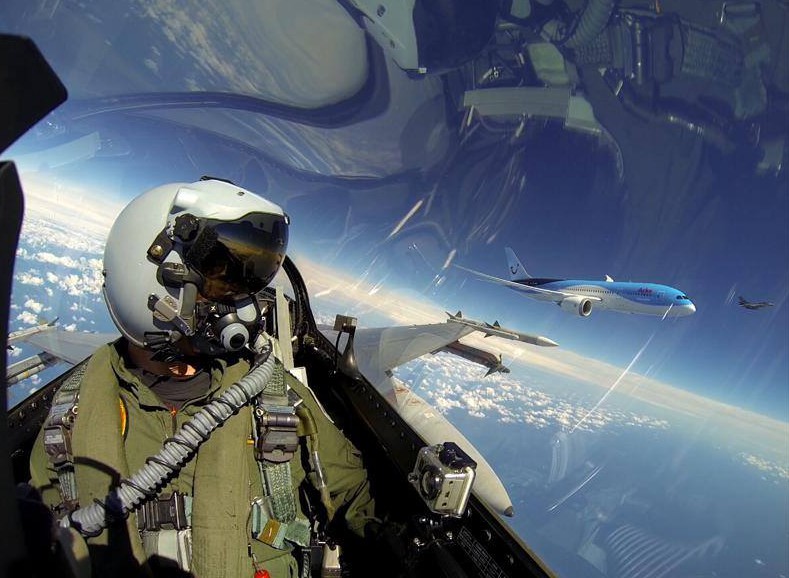
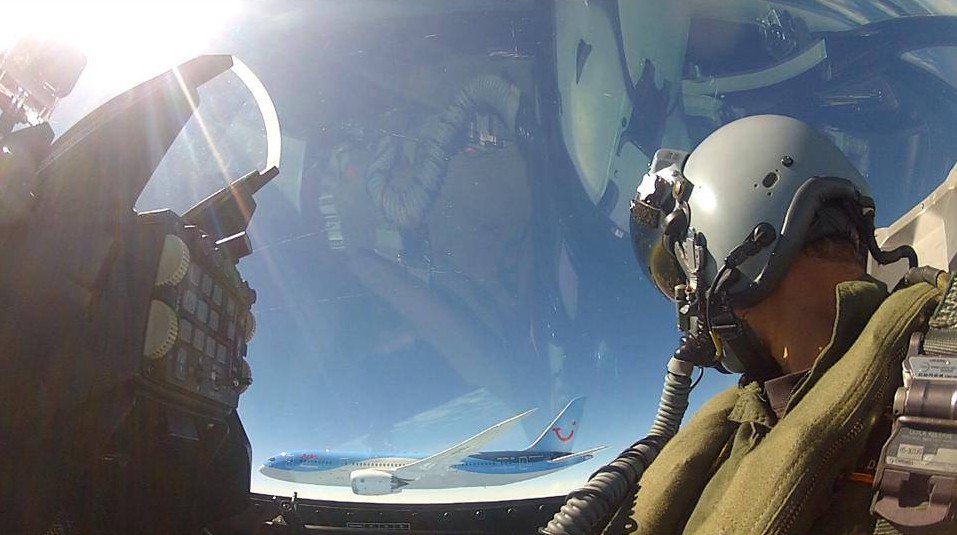
Selfie with Dreamliner: F-16 pilot takes self-portrait photo with Boeing 787 on his left wing

Here’s an interesting series of selfies, taken by GoPro cameras, showing Arkefly airline’s first 787-8,  the first Dreamliner in the Netherlands, welcomed by the RNlAF (Royal Netherlands Air Force) F-16 Demo Team.
The RNLAF F-16 Demo Team 2014-2015 is made of personnel from both the 323 and 322 Squadrons, based at Leeuwarden Airbase. The team consists of one display pilot, Captain Jeroen “Slick” Dickens, four display coaches, eight technical specialists and a webmaster.

As the images shows, the Boeing 787 was intercepted by two Dutch F-16s in standard QRA (Quick Reaction Alert) configuration (that is to say, by armed aircraft) whose pilots wore JHMCS (Joint Helmet Mounted Cueing System)instead of the characteristic Demo Helmet you can see in these images.

Sunday, 8 June 2014

Thai Airways reveals new Boeing 787 business class seat

Thai Airways has provided a sneak peak of the new and predictably rather purple 'Royal Silk' business class seats of its Boeing 787 Dreamliner.
This snap, shared via the airline's Instagram account, confirms the airline has gone with a different seat design to the rest of its fleet.
It's the B/E Aerospace Diamond business class seat, which some travellers will already be familiar with through its appearance on United Airlines' own Boeing 787s.
Thai's Boeing 787-8s will sport 24 of these Royal Silk business class seats which are 21 inches wide with a 60 inch pitch and recline to a 78 inch fully-flat bed.
The layout is a standard 2-2-2 abreast configuration, and each business class passenger will see a 16 inch video screen.
We're yet to see the economy seats but Thai tells us there will be 240 of them, "designed in vivid gold and purple and arranged in a 3-3-3 abreast configuration."
The economy seats will be 18 inches wide, with a 32 inch pitch and 11 inch video screen.
Thai expects to take delivert of its first Boeing 787 at the end of month, which will be followed by a series of domestic flights between Bangkok and Chang Mai to bed down the aircraft and train up its crew before the Dreamliner's planned international debut to Perth and Tokyo at the start of September.
Thai Airways will receive its full order of six Boeing 787-8s between July 2014 and June 2015, and also has signed for two of the longer 787-9.
However, rather than buying them outright from Boeing, all of the jets are being leased from International Leasing Finance (ILFC).
The US company is Boeing's largest Dreamliner customer with orders placed for 74 of the next-gen jet, ahead of the 71-plane deal inked by Etihad Airways.

Sunday, 1 June 2014

Air New Zealand orders 14 new Airbus aircraft, the first Boeing 787-9 completes its first flight

Air New Zealand (Auckland) has announced it has placed an order for 10 Airbus A320neo aircraft (above), one A320ceo and three A321neo aircraft (above, image via Airbus). The signing ceremony took place at the IATA annual meeting today in Doha, Qatar. In other news, on May 29 Air New Zealand’s first Boeing 787-9 (ZK-NZE) (above) took to the air for the first time, successfully completing its first production test flight in the skies above Seattle, Washington. The aircraft, which is in Air New Zealand’s signature black livery, is currently in the final phases of the delivery process before being formally handed over to the airline as the new owner.
Air New Zealand is the launch customer for the Boeing 787-9 and has 10 of these stretch versions of the 787 on order. This first test flight is known as a B1 flight where the two pilots put the aircraft through its paces thoroughly exercising its systems to verify performance while at the same time the functionality of every aspect of the cabin is tested in-flight. The distinctive black aircraft departed from Paine Field airport north of Seattle at 1:45 pm (1345) local time. It reached an altitude of 11,800 meters (39,000 feet) and an airspeed of 360 knots which is standard for a B1 flight and returned to Paine Field three hours and ten minutes later.

787 Dreamliner set to land at American Airlines this fall

Rumbling down the runway at New York’s JFK airport, American Airlines pilot Bill Elder points the nose of the Boeing 787 skyward and takes off for Denver. Elder roars over the Atlantic, then banks sharply to the left, back over Queens and then Manhattan. But he is flying too low and triggers a ground-proximity warning as the Empire State Building appears off to the left. Not to worry. The scene is unfolding in a flight simulator at American’s training center in Texas. Elder, American’s fleet training manager, is demonstrating the warning systems that mimic those in an airliner. American will take delivery of its first 787, which Boeing calls the Dreamliner, in November. Passenger flights begin early next year. In the next few months, dozens of American pilots will sit in the same simulator and learn the nuances of the controls before they can fly the real plane. The 787 could be American’s most important new plane since the Boeing 777 in 1999. With its improved fuel efficiency and long range, the 787 could boost the airline’s profit by making many international routes more economical.

A turbulent record

The plane has a turbulent record. Production was delayed two years, and the entire worldwide fleet of 50 was grounded last year after batteries overheated in two planes. Regulators allowed the jets to fly again after Boeing crafted a fix that included encasing the batteries in steel boxes to contain any fires. The Dreamliner was the first big passenger jet to use lithium-ion batteries to power key systems. Last month, U.S. safety officials said the Federal Aviation Administration relied too much on Boeing for technical expertise and might not have adequately tested the batteries for hazards because of short-circuiting. Experts believe lithium-ion batteries can short-circuit without warning, the investigators said.

American Airlines Group Inc. declined to make an executive available for comment. In a statement to The Associated Press, the airline said it was “in constant dialogue with Boeing and we look forward to adding the 787 to our fleet.” American’s former CEO and current chairman, Tom Horton, similarly stood by Boeing last year. American will become just the second U.S. airline, after United, to fly the 787. Worldwide, about 140 are flying today, and Boeing says it has orders for nearly 900 more. American has ordered 42 Dreamliners but hasn’t yet said which routes they will fly. Spokesman Casey Norton said the plane will be tested on domestic routes before going into international service — the same strategy used by United Airlines.

International flights?

Richard Aboulafia, a prominent aviation consultant, said the Dreamliner will be crucial for American as it competes with United and Delta to attract premium passengers on international routes. He suggests American will fly it to Asia, the Middle East and secondary cities in Europe.

“It is absolutely the plane you want to fly point-to-point internationally,” he said, “and it’s at its best at longer ranges” where the fuel efficiency pays off most.

United executives say the plane burns 20 percent less fuel than similar jets and scores highest in the airline’s surveys of passengers. United plans to use the 787 on new flights this year between San Francisco and Chengdu, a Chinese city that has never had nonstop service from the U.S., and between Los Angeles and Melbourne. The 787 “has allowed us to add more spokes to our network and do it economically,” said United’s vice president of network operations, Brian Znotins. The airline has 65 more on order, including new larger versions. American won’t say how much it will pay for the planes. The base model lists for $211.8 million on Boeing’s website, but airlines routinely get deep discounts.

Expensive simulator

Even the simulator wasn’t cheap. American wouldn’t comment, but a spokeswoman for the manufacturer, Canada’s CAE, said that a 787 simulator would be at the “upper end” of a range between $11 million and $20 million. Depending on their experience, American pilots will spend anywhere from 10 days to nearly a month in the simulator before graduating to practice flights with the real plane. Then come passenger trips, when they will be accompanied by an instructor called a check airman. Jim Dees, American’s training program chief for the 787 — he and Elder are the only American pilots who have flown a Dreamliner — said the simulator allows pilots to practice during emergencies and bad weather that wouldn’t be safe in a real plane.

They can pick from nearly two dozen airports for takeoffs and landings, including over-water approaches at San Francisco or mountainous terrain around Salt Lake City. Letting a reporter take the first officer’s seat, the pilots had him pull the nose up, push it down and roll from side to show how the 20,000-pound device with six gigantic legs simulates the rocking of a plane in flight. They even let him “land” in Denver.

“The feel on the controls,” Elder said, “is just as if you were on an airplane.”

Thursday, 29 May 2014

The Boeing 787 is granted extended 330 minutes ETOPS

Boeing (Chicago and Seattle) has released this statement about extended ETOPS for the 787:
The U.S. Federal Aviation Administration (FAA) has approved additional extended operations (ETOPS) for the Boeing 787 Dreamliner. The move will allow 787s to be operated up to 330 minutes from a landing field and signals continued confidence in the airplane’s technical capabilities.
Dreamliners have been allowed to operate up to 180 minutes away from a landing field since they were introduced into service in 2011. Granting of the expanded operational permission will allow airlines to introduce additional routes after they meet the proof of capabilities requirements and receive approval from their own regulatory agencies for such operations.
ETOPS operations will make the 787 even more efficient in operations as they enable more direct flight paths, which can save thousands of pounds of fuel and reduce carbon emissions.
More than 1,030 787s have been ordered by 60 customers to date. Boeing has delivered 146 Dreamliners to 19 customers.

Wednesday, 28 May 2014

Boeing 787 Flights Extended

Boeing 787 operators have received FAA approval to fly Extended Operations (ETOPS), a development that the company says will enable aircraft to fly on a wider range of routes and to more destinations. 

The ETOPS approval allows 787s to be operated for up to 330 minutes (5.5 hours) away from an airport, up from the previous 180 minutes. The FAA's approval is a sign of confidence in the aircraft that received negative publicity throughout 2013 after incidents involving its lithium-ion battery system grounded the global 787 fleet for more than three months. 

"Our customers are eager to expand their 787 operations," said Larry Loftis, vice president and general manager, 787 program, Boeing Commercial Airplanes. "We're delighted that this capability, which was designed into the airplane from the very beginning, has been certified." 

Boeing announced the ETOPS approval less than one week after the National Transportation Safety Board (NTSB) issued recommendations to the FAA for an improved certification process for lithium ion batteries installed on aircraft. Last year the 787's lithium ion battery system was redesigned following the global fleet grounding in order to prevent overheating. 

To date, Boeing has delivered 146 Dreamliners to 19 different customers, and has received 1,030 orders for the aircraft from 60 different customers. The company plans on an entry into service for two new versions of the aircraft with the 787-9 toward the end of this year, and the 787-10 in 2016.

Saturday, 24 May 2014

Ethiopian Airlines receives seventh Dreamliner

Ethiopian Airlines has taken delivery of its seventh B787 Dreamliner. The carrier, which was one of the first in the world outside of Japan to receive the aircraft, will take three more B787s later on this year.
Ethiopian Group CEO Tewolde Gebremariam said, “We currently have the youngest fleet in Africa with an average age of 7 years.
“In line with our 15 year strategic roadmap of fast, profitable and sustainable growth, Vision 2025, we will continue to expand and modernize our fleet in order to continue to provide maximum comfort to our customers.”
Ethiopian currently serves 80 international destinations across 5 continents with more than 200 daily flights.

Sunday, 18 May 2014

Air Canada receives first Boeing 787

Air Canada has taken delivery of it first Boeing 787-8 Dreamliner. The aircraft, the first of Air Canada's 37 787s on order for delivery through 2019, departed Paine Field in Everett, Wash. Sunday on its delivery flight to Toronto.
“The 787 Dreamliner will immediately make a dramatic improvement to our fleet capabilities,” Air Canada president and CEO Calin Rovinescu said. “The improvement in fuel use is extremely exciting for us. The range and economics unlock new destinations for customers, who will love the innovative look and comfort onboard.”  
Air Canada has announced it will use the 787 on its Toronto-Tel Aviv routes, as well as launch a new destination – Tokyo’s Haneda Airport. The 787 is 20% more fuel efficient than the Boeing 767s it will replace.
The 787 launches Air Canada’s new international business class cabin with 20 seats. There are 21 seats in premium economy and and 210 seats in economy.
The airline has ordered 15 787-8s, including the launch delivery aircraft, and 22 787-9s, all powered by General Aviation GEnx engines.
As part of its 787 deal, Air Canada will receive flight and maintenance training and in-flight pilot training services from Boeing.

Friday, 16 May 2014

Scoot to receive its first Boeing 787 in November, will become the first all-787 carrier

Boeing (Chicago and Seattle) and Scoot (Singapore) have announced a five-year pilot training agreement to support the airline’s fleet transition to 787-9 Dreamliners.
Under the agreement, Boeing Flight Services, a business unit of Boeing Commercial Aviation Services, will provide 787 flight training to Scoot pilots at Boeing’s Singapore training campus. In 2014 alone, an anticipated 32 Scoot pilots will undergo training.
The 2013 Boeing Pilot & Technician Outlook, a respected industry forecast of personnel demand, projects a requirement for 498,000 new commercial airline pilots and 556,000 new maintenance technicians to fly and maintain the new airplanes entering the world fleet over the next 20 years. In Southeast Asia, 51,500 pilots and 64,700 technicians are needed to fill the gap.
Scoot will acquire 20 Boeing 787-9s beginning in November 2014. A second 787 is due ar the end of February 2015. The airplanes were originally ordered by parent company Singapore Airlines. Scoot currently operates Boeing 777-200s on medium and long haul low-cost flights between Singapore and Sydney, Gold Coast, Bangkok, Taipei, Tokyo, Tianjin, Shenyang, Nanjing, Qingdao, Seoul, Perth and Hong Kong.
Scoot is expected to introduce the new type in December on its routes.

Friday, 9 May 2014

Norwegian signs agreements to lease three new 787-9 Dreamliners


Norwegian has signed agreements to lease three new Boeing 787-9 Dreamliners for its long-haul operation. Two of the aircraft will be delivered in 2016 and one in 2017. This is the brand new, more environmentally friendly and even larger Dreamliner model, which is scheduled to enter commercial service this year.

Norwegian continues to expand its international operation by signing agreements to lease three Boeing 787-9 Dreamliner aircraft. Two of the aircraft are scheduled to enter service in 2016, while the third is scheduled to enter service in 2017. Today, Norwegian has five 787-8 Dreamliner aircraft in its fleet and another three on order. In addition, the company has six 787-9 Dreamliners on order. With the new order announced today, Norwegian will have 17 aircraft in its long-haul fleet in 2018.

Facts about Boeing 787-9 Dreamliner:

  • Accommodates up to 20 % more passengers than the 787-8 Dreamliner
  • 6 meters (20 feet) longer than the 787-8
  • Significantly increased cargo capacity compared to the 787-8
  • 8% lower fuel consumption per seat than today’s model, which also means lower emissions
  • Can fly longer than the 787-8 (depending on cabin configuration).

The airlines company reported its first quarter results for 2014. The pre-tax profit (EBT) was -813 MNOK. Despite a seasonally weak quarter, the passenger growth is strong and the load factor high. The quarterly results are affected by the additional costs associated with wet-leasing replacement aircraft on long-haul routes, as well as a weaker Norwegian currency (NOK).  

The total revenue in the first quarter was 3.55 BNOK, up 22 percent from the same quarter previous year. The company carried 4.9 million passengers, a growth of 24 percent. The company’s traffic growth (RPK) was up as much as 50 percent, which means that Norwegian’s passengers fly considerably longer distances than they did a year ago.

The first quarter results are also characterized by a solid production growth (ASK) with an increase of 48 percent. The load factor was 77 percent, up one percentage point compared to the same quarter last year. Adjusted for one-off costs and a weak Norwegian currency (NOK), the unit cost (CASK) was reduced by nine percent.

Additional costs related to the long-haul operation amounted to 78 MNOK in the first quarter. This includes wet-lease costs, additional fuel, as well as costs for accommodation, food and drink for delayed passengers who have been affected by the technical and operational problems associated with the long-haul operation.

During the first quarter, Norwegian has taken delivery of five new Boeing 737-800s and one Boeing 787-8 Dreamliner. This morning, Norwegian announced an order of an additional three 787-9 Dreamliners. Norwegian currently has five Dreamliners in its fleet as well as 12 on order. See separate press release.

“Traditionally, the first quarter is seasonally weak and in addition the figures have been significantly affected by a weak Norwegian currency (NOK) against the dollar and the euro. Also, the wet-lease of aircraft has negatively impacted the quarterly result. On the positive side, the passenger growth is strong and the load factor continues to rise, even with the company’s strong production growth. The strong competition in Norway reflects the prices, but Norwegian is becoming increasingly equipped to meet this competition,” said CEO Bjorn Kjos. - See more at: http://www.traveldailynews.com/news/article/60370#sthash.NuQy61c7.dpuf

Wednesday, 7 May 2014

Virgin Atlantic might bet big with bigger Boeing 787

Richard Branson's Virgin Atlantic Airways Ltd. might decide to add some stretched-out Boeing Co. 787-10 models to its fleet.
Branson told Bloomberg that "it would make a lot of sense for us" to fly the bigger (323 seats to the 787-9's 280 seats) airplane, and the English airline probably would place new orders for the 787-10 and wouldn't convert any of its existing 16 orders for the 787-9 airplane into 787-10 orders.
Boeing (NYSE: BA) started to offer the 787-10 in 2013, and deliveries are supposed to begin in 2018.

Sunday, 27 April 2014

Boeing will save $60,000 per job by moving engineering center to Alabama; average salary will be $89,000

The relocation of a Boeing engineering center from Washington state to Alabama is part of an effort to save more than $100 million a year, documents from the company show.
Boeing announced late last year it will move as many as 400-high paying engineering jobs to Huntsville as part of what the company described as a reorganization and realignment of its research and technology operations. The 400 jobs are among 2,000 technology positions that are being divided among centers in southern California; St. Louis, Mo.; North Charleston, SC; and Seattle, Wash.


The realignment will add jobs in Alabama, Missouri and South Carolina but existing centers in Washington state and California will lose a combined 1,200 positions.
Huntsville's center will focus on simulation and decision analytics and metals and chemical technology, according to company officials.

Internal documents obtained by the Seattle Times said the realignment will cost Boeing $150 million to implement but save as much as $100 million a year after 2016, due mostly to lower wages in the new areas. Each engineering job moved to a new state, the documents show, will produce an annual savings of $60,000 in pay and benefits. 
Boeing officials did not dispute the figures cited in the Times but said cost was just one element in making the decision to move the centers.

Boeing vice president Jim Schlueter said the company also plans to "gain access to new talent," and reduce its "footprint where we are not as productive as we should be."
The documents show as many 40 percent of the jobs at the new centers will be entry-level engineering positions. The projected average salary at the new centers would be $89,000 versus $125,000 at the Washington state/Southern California locations. With benefits added in, the company expects to spend $152,000 per engineering position at the new centers compared to $212,000 at its existing locations.

The realignment will dramatically change Boeing's engineering presence in Huntsville, the Times reports. Currently, about 1 percent of the company's engineering workforce is located in Huntsville. By 2016, that percentage will grow to 12 percent, equal to the amount in southern California.

Wednesday, 9 April 2014

United’s First Boeing 787-9 Rolls out of Final Assembly

United Airlines’ first Boeing 787-9 Dreamliner rolled out of the manufacturer’s final assembly facility at Everett in Washington on the evening of April 8.
The roll-out marks the first major milestone in the aircraft’s production ahead of its expected delivery to United Airlines this summer. The Boeing 787-9 is the second member of the 787 Dreamliner family.
With its fuselage stretched 20 feet longer than the Boeing 787-8, United’s 787-9 will fly more than 30 additional passengers and up to 300 nautical miles farther with the same environmental performance, burning up to 20 per cent less fuel per seat and up to 20 per cent lower emissions than similarly sized, previous-generation aircraft. United Airlines is the North American launch customer for the aircraft.
“The 787-9 is an amazing aircraft that builds on the 787-8′s proven fuel efficiency, performance and customer comfort,” says Ron Baur, United’s vice president of fleet. “We are excited to add the 787-9 to our Dreamliner fleet as it gives us even more flexibility and range to capitalize on our extensive worldwide route network.”
Earlier this year, United announced that it will operate Boeing 787-9s on non-stop flights between its hub at Los Angeles International Airport and Melbourne in Australia, beginning in October.
On March 12, 2007, before merging with United Airlines, Continental Airlines ordered five Boeing 787-9 Dreamliners and contracted to convert 12 previously ordered 787-8 jetliners to the larger 787-9s. Subsequently, United added orders for nine more 787-9s, for a fleet total of 26 by mid-2014. As of then, United had a total of 65 Boeing 787s in service or on order, including 20 787-10s
The airline will fly the route six times weekly with Boeing 787-9s. United will be the first North American carrier to take delivery of the 787-9, and this will be the airline’s first international deployment of the aircraft type.
Over the next several months, United’s first 787-9 will move to the next phase of completion, which includes final cabin configuration and painting. United’s 787-9 will be configured with 252 seats – 48 in United BusinessFirst and 204 in United Economy, including 88 Economy Plus seats with added legroom and increased personal space.
United’s first 787-9 will also be one of five aircraft used by Boeing in a flight test program to certify the type.
To date, United has flown its 787 fleet more than 30,000 hours on over 4,400 flights. The airline now operates 10 Boeing 787-8s and has an additional 55 Dreamliners on order, including 26 Boeing 787-9s and 20 Boeing 787-10 widebodies.

Wednesday, 2 April 2014

LOT Polish Airlines Swings to Net Profit, Says Boeing 787 Helps

After years of heavy losses that pushed it to the brink of bankruptcy, state-owned carrier LOT Polish Airlines swung to a symbolic net profit in 2013, saying Wednesday it boosted passenger numbers and saved fuel by using Boeing Co.'s 787 Dreamliner jets.
LOT made 26 million zlotys ($8.6 million) compared to a loss of nearly PLN200 million it had projected for the year in a restructuring program sent to the European Commission. The company is on the radar of the European Union executive after tapping PLN400 million in a government loan in 2012 that saved it from insolvency.

Saturday, 29 March 2014

Qatar Airways to serve Edinburgh wiith 787 Dreamliner

Qatar Airways has announced plans to launch the first service to Scotland using a new Boeing 787 Dreamliner.
CEO Akbar Al Baker said the new scheduled service from Edinburgh to Doha will launch on May 28, making it the first direct route from the capital city to the Middle East.
He said the new addition is set to significantly reduce journey times for those travelling from Edinburgh to destinations around the world.

Thursday, 20 March 2014

FAA Review Says Boeing 787 Dreamliner Safe

The Boeing 787 Dreamliner, grounded for months last year after battery overheating problems, is soundly designed and safe to fly, a joint review by the plane maker and the Federal Aviation Administration said on Wednesday.
The review, which was initiated by the FAA after a battery fire aboard a 787 in Boston in January 2013, encompassed the