Showing posts with label Air Travel. Show all posts

Tuesday, 20 May 2014

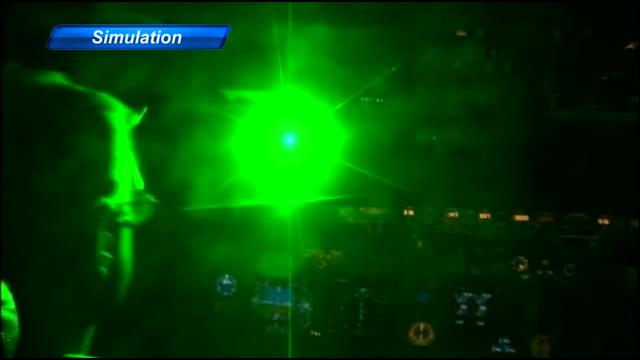
Laser Pointers Blinding Pilots

It's a danger to air travel growing nationwide, and until recently was not a problem in Montana. But, that is starting to change. It's pilots being blinded by laser pointers. KULR-8 News' Emily Nantz tells us why it's a growing problem.
"They call it tagging airplanes or something like and lasering airplanes," says Kevin Ploehn, Director of Aviation & Transit at Billings' Logan International Airport.
It might not seem like a big deal to you and me, but to pilots it's a real danger.
Laser pointers aimed a planes in flight - especially when the planes are taking off or getting ready to land.
"It's a tremendous distraction in the flight deck, it's a very real safety hazard and it brings in the very real possibility of having an airplane accident as the result of this action," says Capt. Robert Hamilton, Airlines Pilots Association International.
Though a pinpoint beam on the ground at a couple of thousand feet, the beam spreads out and it can totally blind a pilot.
"A lot of times it's younger people and they're just goofing off, and what they don't understand that if it hits a pilots eyes and he's say on approach for landing, it's almost like getting a big flashbulb going off in your face, you get that residual can't see anything, so now they are coming in for a landing without any vision," says Ploehn.
In 2005, there were 283 laser incidents. Last year that number was up to 3,960.
Though there were only 7 reported in Billings, and it may be relatively new to our area, but not the airports we fly to including Chicago, Denver, Salt Lake City and Seattle.
"The risks are high for doing it, it's not a good thing, very dangerous, could cause some problems, if you've got a plane with 150 people on it and all of the sudden a pilot can't see, that's not a good thing."
"I wonder how stupid people really can be. I wonder if people really understand that when they shine a laser in the eye of a pilot that they could cause great harm if the pilot is not able to continue to fly the plane safely," says Ray LaHood, former Secretary of Transportation.
The government takes this very seriously, dozens of cases around the country of people going to prison for lasering.
"There has never been a recorded case of an airplane crashing because of the airplane being blinded, the pilot being blinded, but there have been thousands of cases, and it's only a matter of time till something bad happens," says Dan Hargrove, Director of Aviation at Rocky Mountain College.
He knows it's not just planes that could be a problem.
"I'd like to warn anyone that has a laser pointer to really think through what you're going to use it for. And if it's night time and you're out in your backyard and you're just having fun with it, don't put it at a vehicle, don't point it at a moving truck and certainly don't point it at an aircraft cause blinding that person in that piece of machinery obviously can have safety problems."
According to the FBI, the penalty for aiming a laser pointer at a plane and interfering with the operation is a maximum of 20 years in prison and a $250,000 fine.

Friday, 16 May 2014

How to get compensated for air travel delays

Last summer, Mark Wilson waited in a Rome airline terminal for a connecting flight to London on his way home to New York. And waited. And waited. By the time he arrived in London four hours late, the final New York-bound flight had departed.

Wilson was offered a room at an airport hotel, which he declined. He was also due a $550 cash penalty by U.S. law but says he never knew about the rule. The money sat unclaimed for more than two months, until he used the service Refund.me to collect.

“I travel constantly. I had no idea that law existed,” says Wilson, 36, an investment banker.

Indeed, the right of consumers to collect cash from airlines for international as well as domestic flight delays is not well known, says Christopher Elliott, author of “How to be the World’s Smartest Traveler” and ombudsman for National Geographic Traveler. “The rules are obscure, and airlines intentionally keep them that way.”

Consumers can fill out the required forms themselves and deal directly with the airlines. You can access the U.S. forms through the Department of Transportation’s Aviation Consumer Protection Division. European fliers can find forms at individual airlines or through the European Union.

But some prefer to skip the extra paperwork and hire someone else to handle it, even though it will cost a hefty percentage of what’s recovered. Service providers include AirHelp and Refund.me.

Either way, fewer than 2 percent of eligible travelers try to claim the cash, and less than 1 percent of travelers receive money, says Nicolas Michaelsen, co-founder and chief marketing officer of AirHelp.

RULES FOR PAYMENTS

Passengers whose flights from Europe are delayed by at least three hours or canceled are eligible for up to about $825, depending on the length of delay and distance of the flight. The average payout is around $600, according to Michaelsen. Flights to Europe and within Europe on an European Union-based carrier are also subject to European Union law.

Domestic U.S. travelers may be eligible for even more money, but under much narrower circumstances. An airline that denies a booked passenger a seat (somebody who is bumped on an oversold flight because there are not enough volunteers to give up seats) and can’t get to their destination within an hour of the scheduled time can collect 200 percent of the one-way ticket price, capped at $650.

A delay of two or more hours is worth 400 percent of the price of the one-way ticket, up to $1,300. The average payout is $643, AirHelp says.

In 2013, nearly 467,000 passengers were bumped from overbooked U.S. flights, according to U.S. Department of Transportation records. A routine airline practice can end your eligibility for a cash payment: if an airline offers you a voucher and you accept it.

“Then all bets are off,” Elliott says.

Data shows that most people take the voucher when offered - only about 57,000 U.S. domestic travelers last year were involuntarily bumped. Airlines are supposed to hand those consumers the rules that govern being bumped from a flight, and payment is supposed to be immediate. But that’s not always the case, travel experts say.

However, United Airlines spokesman Charles Hobart says passenger gate agents are told to immediately settle up with travelers due a payment.

Delta Air Lines last year was fined $750,000 by the Department of Transportation for not following the rules. The airline has since invested in additional training and electronic signature pads to document that passengers were properly notified and compensated, spokesman Morgan Durrant says.

So far, AirHelp has processed about 25,000 claims and says a majority of applicants received a payout, with AirHelp taking a 25 percent commission including tax. Refund.me has a two-tier fee, starting at 15 percent commission plus tax for those who return a signed power of attorney form within 28 days, and 25 percent plus tax for those who turn it in later.

A typical case works like this: Connie Lee, 31, of Oakland, California, was delayed on a trip home from Germany. She filled out an online AirHelp form once she got home, which took about five minutes. A couple of weeks later, Lee ended up receiving about $800 from her airline carrier, minus the company’s 25 percent commission.

“It was a very good surprise,” Lee says.

Friday, 25 April 2014

7 ways air travel changed after air disasters

One of the key questions asked after any serious airline incident is: how do we stop this happening again?
Malaysia Airlines has already changed its cockpit regulations as a result of Flight 370's disappearance.
Many other incidents in the past have led to safer flying conditions for us today, as a result of improvements and changes to protocol, laws and technology in planes. Below we outline some of the most important ones.
These helped pave the way to making 2013 one of the safest years in aviation history according to the Aviation Safety Network, with only 29 known accidents worldwide, and 265 fatalities (the 10-year average is 720 fatalities per year).
1. Collision Avoidance Systems
Collision Avoidance Systems have been a priority in the aerospace industry since the inception of flight.
In 1956, a TWA jet crashed into a United Airlines flight above the Grand Canyon. The incident was the first of many that illustrated the need for increased communication between planes.
A few years later, the Federal Aviation Administration (FAA) was formed to set guidelines for aviation in the United States, but still, issues remained.
Several other two-plane accidents -- including a 1996 collision near New Delhi that resulted in 349 casualties -- emphasized the need for advanced, anti-collision technology.
After a congressional ruling in 1991, the FAA implemented the Traffic Alert and Collision Avoidance System (TCAS), which monitors the airspace around an aircraft independent of air traffic control.
"TCAS really came about in the late '90s, and since then, I don't think we've really seen a collision between two airlines," notes Phil Seymour, president and COO of the International Bureau of Aviation, a consultancy that offers analysis and advice to the aviation industry.
2. Roomier seats
Coach may seem pretty crammed these days, but according to Seymour, there's a limit to how much plane manufacturers are allowed to shave off the space around seats.
In fact, modern-day seat layout has been rigorously calculated to carry out the most effective evacuation.
This is in part thanks to research carried out by the Cranfield Institute after a 1985 incident, when a British Airtours 737 caught fire before take-off at Manchester International Airport.
An engine caught fire, and the flames spread quickly. Unfortunately, the lack of space between seats meant that bottle-necking occurred at the doors, and some passengers couldn't escape.
"The aisles became jammed with people panicking to exit, and there literally wasn't enough space between the seats," recalls Seymour.
"Now, there are limits in terms of the minimum space between seats as well as the distance to an emergency exit."
3. Weather radar
Severe weather has played a role in some crashes, Delta Airlines Flight 191, most notably, which crashed in 1985 while approaching Dallas-Fort Worth International Airport in a thunderstorm.
"Rain is one thing, but if a pilot gets into wind shear, and the currents are there, it will literally just push your aircraft onto the ground. There have been some incidents where aircraft have crashed when making their final approach," says Seymour.
In 1981, the FAA required all turbine-powered commercial planes be installed with wind shear detection systems by 1993. Since then, the models have become increasingly sophisticated.
"A lot of the more advanced weather radar don't just detect bad weather, but predict wind shear. If a pilot sees wind shear coming, instead of landing, he can circle around the airport until it disappears."
4. Manual training
It took two years for search parties to recover the black box from Air France Flight 447, which crashed into the Atlantic Ocean en route to Paris from Rio.
On reviewing the recordings, the French Bureau d'EnquĂȘtes et d'Analyse (BEA) blamed pilot error, in particular an overdependence on the automated flight control system.
"The senior captain was on his break, and the aircraft was being piloted by two less experienced pilots," recalls Seymour. "Since then, Airbus and Boeing have both changed their operation procedures, and have put more focus on manual training," he adds.
In the wake of the incident, Air France also revamped its training procedures, and introduced a new "gatekeeper" position.
Gatekeepers are tasked with contacting the flight crew in the event of an incident and providing pilots with on-the-spot training, tools and advice.
5. Retiring old planes
The FAA addressed the issue of how long planes should fly in 1988 when they created the National Aging Aircraft Research program, which monitors the structural integrity of older planes.
The measure was a result of an Aloha Airlines accident. While flying at 24,000 feet, a large section of the roof blew off, leaving passengers flying in the open air.
The plane -- a Boeing 737 -- was 19 years old, and investigators blamed the incident on the plane's age-related wear and tear.
6. Reviewing repairs
When it comes to making repairs to old aircraft, airlines have also become increasingly stringent.
This is mainly the result of Japan Airlines Flight 123, which crashed in the mountains 62 miles from Tokyo. The crash was the result of a poorly executed repair made several years earlier.
"The repair covered a crack in the bolt head, but many hundreds of flights later, it corroded and the air pressure bolt head just burst open," recalls Seymour.
Boeing responded by monitoring their repairs more closely.
"After that, the types of repairs allowed on an aircraft skin were much more rigorously controlled," says Seymour.
7. Retrieving data
Both the Air France 447 crash and the more recent incident involving Malaysia Airlines Flight 370 have spotlighted the need for better access to data.
"There were several recommendations stemming from AF447, mainly centered around the flight data recorders and, more specifically, on ensuring the ability to locate them more easily and quickly," says Ilias Maragakis, communications officer for the European Aviation Safety Agency (EASA).
In the aftermath of the Air France incident, EASA published a notice of a proposed amendment to retire older recording technologies and recommended that cockpit voice recorders have a minimum recording duration of two hours.
Unfortunately, it may be a while before the necessary changes are implemented.
"Changes to regulations do take time. It's taken almost two decades for aircraft to be manufactured and older aircraft to be modified to have a system that means an empty fuel tank can't explode on an aircraft," Seymour points out.